

Health Library
Potter syndrome
Potter phenotype; Potter's syndrome
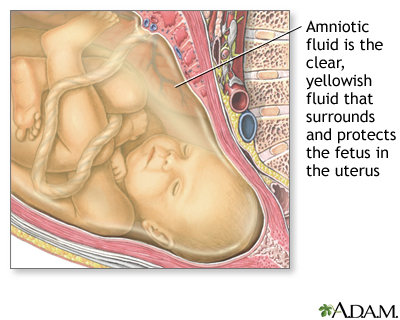
Potter syndrome and Potter phenotype refers to a group of findings associated with a lack of amniotic fluid and kidney failure in an unborn infant.
Images
I Would Like to Learn About:
Causes
In Potter syndrome, the primary problem is kidney failure. The kidneys fail to develop properly as the baby is growing in the womb. The kidneys normally produce the amniotic fluid (as urine) that surrounds the unborn baby.
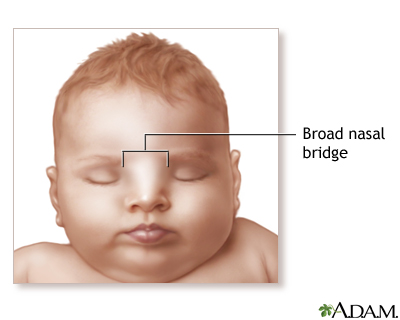
Potter phenotype refers to a typical facial appearance that occurs in a newborn when there is no amniotic fluid. The lack of amniotic fluid is called oligohydramnios. Without amniotic fluid, the infant is not cushioned from the walls of the uterus. The pressure of the uterine wall leads to an unusual facial appearance, including widely separated eyes.
Potter phenotype may also lead to abnormal limbs, or limbs that are held in abnormal positions or contractures.
Oligohydramnios also stops development of the lungs, so the lungs do not work properly at birth.
Symptoms
Symptoms include:
- Widely separated eyes with epicanthal folds, broad nasal bridge, low set ears, and receding chin
- Absence of urine output
- Difficulty breathing
Exams and Tests
A pregnancy ultrasound may show lack of amniotic fluid, absence of fetal kidneys, or severely abnormal kidneys in the unborn baby.
The following tests may be used to help diagnose the condition in a newborn:
Treatment
Resuscitation at delivery may be attempted pending the diagnosis. Treatment will be provided for any urinary outlet obstruction.
Outlook (Prognosis)
This is a very serious condition. Most of the time it is deadly. The short-term outcome depends on the severity of lung involvement. Long-term outcome depends on the severity of kidney involvement.
Prevention
There is no known prevention.
Related Information
Acute kidney failureAmniotic fluid
Epicanthal folds
Broad nasal bridge
Low-set ears and pinna abnormalities
Micrognathia
Contracture deformity
Renal
References
Marcdante KJ, Kliegman RM, Schuh AM. Congenital and developmental abnormalities of the urinary tract. In: Marcdante KJ, Kliegman RM, Schuh AM, eds. Nelson Essentials of Pediatrics. 9th ed. Philadelphia, PA: Elsevier; 2023:chap 168.
Mitchell AL. Congenital anomalies. In: Martin RJ, Fanaroff AA, eds. Fanaroff and Martin's Neonatal-Perinatal Medicine. 12th ed. Philadelphia, PA: Elsevier; 2025:chap 29.
Miyashita Y, Formeck C, Moritz M. Nephrology. In: Zitelli BJ, McIntire SC, Nowalk AJ, Garrison J, eds. Zitelli and Davis' Atlas of Pediatric Physical Diagnosis. 8th ed. Philadelphia, PA: Elsevier; 2023:chap 14.
BACK TO TOPReview Date: 7/1/2025
Reviewed By: Charles I. Schwartz, MD, FAAP, Clinical Assistant Professor of Pediatrics, Perelman School of Medicine at the University of Pennsylvania, General Pediatrician at PennCare for Kids, Phoenixville, PA. Also reviewed by David C. Dugdale, MD, Medical Director, Brenda Conaway, Editorial Director, and the A.D.A.M. Editorial team.
 | A.D.A.M., Inc. is accredited by URAC, for Health Content Provider (www.urac.org). URAC's accreditation program is an independent audit to verify that A.D.A.M. follows rigorous standards of quality and accountability. A.D.A.M. is among the first to achieve this important distinction for online health information and services. Learn more about A.D.A.M.'s editorial policy, editorial process and privacy policy. A.D.A.M. is also a founding member of Hi-Ethics. This site complies with the HONcode standard for trustworthy health information: verify here. |
The information provided herein should not be used during any medical emergency or for the diagnosis or treatment of any medical condition. A licensed medical professional should be consulted for diagnosis and treatment of any and all medical conditions. Links to other sites are provided for information only -- they do not constitute endorsements of those other sites. No warranty of any kind, either expressed or implied, is made as to the accuracy, reliability, timeliness, or correctness of any translations made by a third-party service of the information provided herein into any other language.
© 1997-
2026 A.D.A.M., a business unit of Ebix, Inc. Any duplication or distribution of the information contained herein is strictly prohibited.
All content on this site including text, images, graphics, audio, video, data, metadata, and compilations is protected by copyright and other intellectual property laws. You may view the content for personal, noncommercial use. Any other use requires prior written consent from Ebix. You may not copy, reproduce, distribute, transmit, display, publish, reverse-engineer, adapt, modify, store beyond ordinary browser caching, index, mine, scrape, or create derivative works from this content. You may not use automated tools to access or extract content, including to create embeddings, vectors, datasets, or indexes for retrieval systems. Use of any content for training, fine-tuning, calibrating, testing, evaluating, or improving AI systems of any kind is prohibited without express written consent. This includes large language models, machine learning models, neural networks, generative systems, retrieval-augmented systems, and any software that ingests content to produce outputs. Any unauthorized use of the content including AI-related use is a violation of our rights and may result in legal action, damages, and statutory penalties to the fullest extent permitted by law. Ebix reserves the right to enforce its rights through legal, technological, and contractual measures.
